
Case Study: How BlackHawk Industrial Turned a Unified Quota Model into Its Best Quarter Ever
.png)

The commercial models of many manufacturers and distributors are built for retention rather than growth. In complex organizations like BlackHawk Industrial, that can be challenging to change.
BlackHawk built its business in cutting tools and metalworking, running on a vendor-managed inventory model: on-site vending machines dispense products directly to customers, with BlackHawk responsible for keeping them stocked.
As the company grew under private equity investment, it rounded out its product range through acquisition, most notably by adding a large fasteners business and expanding into PPE and safety. That strategy increased BlackHawk’s growth potential, but it also meant the existing commercial function wasn't designed to match the scale of the new offering.
Each acquired business arrived with its own territory reps and incentive plans, creating overlapping coverage, inconsistent behaviors, and no unified growth model.
The traditional territory setup added to the strain. One rep owned everything: new logos, expansion, renewals, and all the service issues that came up. Urgent customer problems always came first, which meant prospecting for new business only happened when there was time.
Margin pressure intensified the challenge. Tariffs were squeezing distributors sourcing internationally, and margin across the business came under pressure, driven mainly by erosion within existing accounts. Growth from new customers wasn't enough to offset the margin erosion from existing customers, and a lack of compensation alignment was amplifying the problem, with 75+ incentive plans in place.
We supported BlackHawk to address these issues. We increased focus on new logos with dedicated hunters, and replaced fragmented commission plans with growth-oriented quota plans, driving the growth its private equity owners expected. As John Mark, BlackHawk's CEO, explains:
“Without this initiative [with RevenueShift], account managers would have been a lot more resistant to raising prices. Now, they're appropriately addressing that. Our margins have increased, and volume growth has also improved as a result.” - John Mark, BlackHawk CEO
A diagnostic that changed the conversation
We ran a five-week diagnostic combining interviews, customer insight, time-in-motion analysis, and deep data modeling.
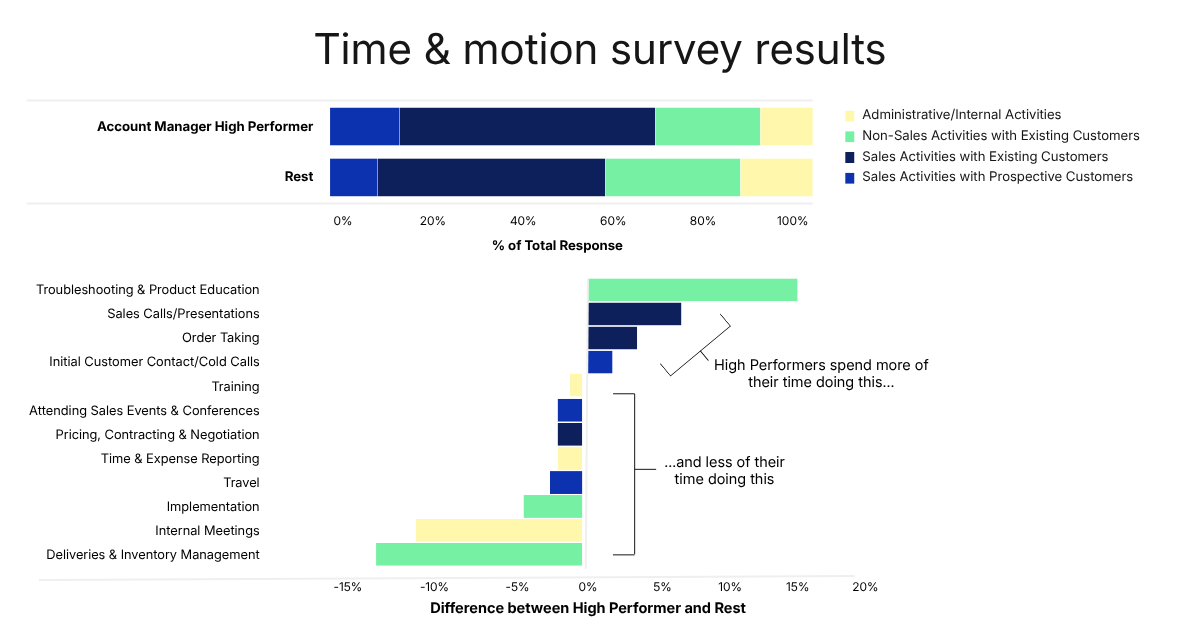
The time-in-motion survey unearthed a particularly revealing number: reps spent just 13% of their time prospecting for new accounts. They spent 40% selling to existing customers, and 47% of their time on non-sales activities.
High performers showed a different pattern - more time hunting and selling, less time firefighting, but the organization wasn't designed to replicate that behavior.
This concrete evidence moved the perspective of leadership beyond a vague sense that reps "weren't prospecting enough" and made the case for change undeniable.
Alongside this, we analyzed six million transactions across three years, combining Salesforce, finance, and HR data to pinpoint exactly where margin was being lost within accounts. Customer interviews added an external view of how BlackHawk was perceived and where service issues were consuming time.
.png)
Building a sales organization designed to win new business
The diagnostic made the growth problem visible and measurable, shaping how we designed the solution, which we split into two parts:
1. Organization and role design
The first design priority was structural: BlackHawk needed a dedicated hunter role focused solely on new business. We mapped the sales process end to end with BlackHawk's team, defining:
- A hunter role responsible for landing new logos
- A clear handoff to account managers once a new customer had been won
- Role responsibilities, sequencing, and collaboration points
- How the roles should report and how talent should be sourced
A key design question was how hunters should target the market - by geography, industry vertical, or product line? Our answer, geographic territories, was driven by two insights:
- Manufacturing buyers still prefer working with someone local
- Geographic alignment allows hunters and account managers to collaborate closely, making handoffs smoother and more credible for customers
This gave BlackHawk a scalable, repeatable model for capturing new logos without losing the local relationships their buyers valued.
2. Incentive design
The second design priority was behavioral. Straight commission was rewarding reps for protecting their existing book - the fear of losing the book was outweighing the incentive to grow it.
We replaced BlackHawk's commission setup with a simple quota model that pushed the team to focus on new business. If reps beat their quota, they earned more than before; if they missed it, they earned less. For the first time, everyone had a clear target and a strong reason to drive hard toward growth.
This shift created urgency where none existed before. Under commission, a rep earned roughly the same whether a sale landed today or next week. Under quota, timing matters and behavior changes.
A sales engine that delivers growth
The redesigned model went live at the start of the calendar year. Within six months, BlackHawk recorded its best second quarter ever, driven by a record-breaking June:
- 9% year-over-year growth in gross margin dollars
- 3.5% ahead of plan
As John Mark, BlackHawk's CEO, notes, the record quarter was enabled by the shift onto the quota model. One of the clearest signs of that impact was a huge sales rally in the final two days of each month, something the business had never experienced before, with reps pushing to hit their number rather than waiting for revenue to arrive.
BlackHawk now has:
- A unified coverage model
- Clear hunting and farming roles
- A compensation plan that rewards growth
- A sales organization aligned to where margin and opportunity are
Most importantly, it has a commercial engine capable of delivering the value creation its investors expect.
If you want a commercial model that's built for growth at the heart of your manufacturing or distribution business, let's talk.
Related Insights //
Explore related insights and strategies for growth.

.png)
.jpg)


Let's Get Started //
Your goals are our goals. We won’t come with one-size-fits-all solutions, and we are committed to finding what works for you. If you’re ready, we’re ready.